By Ravish Handoo
Fresh speculation over a possible Cabinet reshuffle brings Sinha’s future into focus; Vinai Kumar Saxena’s name also emerges as a possible successor following his temporary additional charge of J&K.
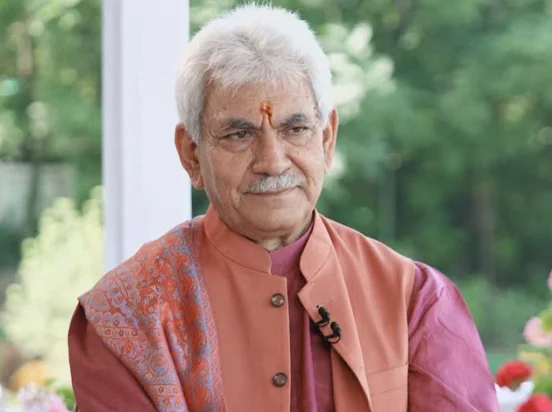
The political corridors of New Delhi are abuzz with speculation over a possible change in the leadership of Jammu & Kashmir following reports suggesting that Lieutenant Governor Manoj Sinha could be brought back into the Union Cabinet. A political report published on November 12 has raised the possibility of Sinha being inducted into Prime Minister Narendra Modi’s Cabinet as the Minister of Human Resource Development, now officially known as the Minister of Education. Although there is no official confirmation from the government, the development has triggered fresh discussions about Sinha’s political future and the possibility of a corresponding change at Lok Bhavan in Jammu & Kashmir.
The speculation places the J&K Lieutenant Governor among the possible candidates for a ministerial position in the next Union Cabinet reshuffle. It is important to note that this is not an official announcement or a confirmed government decision. Neither the Prime Minister’s Office nor the Union Government has confirmed any such proposal. Nevertheless, the possibility has attracted attention because Sinha is not new to the Union Government and has previously held important ministerial responsibilities.
Born on July 1, 1959, in Ghazipur district of Uttar Pradesh, Manoj Sinha is an engineer by education and a seasoned BJP politician. He represented Ghazipur in the Lok Sabha on three occasions, having won elections in 1996, 1999 and 2014. During the first term of the Narendra Modi Government, he served as Minister of State for Railways and subsequently held independent charge of the Ministry of Communications. His administrative experience, political background and familiarity with the functioning of the Central Government make him a potential candidate for another important ministerial responsibility.
Sinha was appointed Lieutenant Governor of Jammu & Kashmir in August 2020, replacing Girish Chandra Murmu, who subsequently became the Comptroller and Auditor General of India. His appointment came at a particularly sensitive stage in the political history of Jammu & Kashmir, following the abrogation of Article 370 and the reorganisation of the erstwhile State into two Union Territories. At the time, the region was without an elected government, and the administration was operating under a significantly altered constitutional and political arrangement.
During his tenure, Jammu & Kashmir witnessed several important developments, including the District Development Council elections, the restoration of an elected government following the 2024 Assembly elections and the emergence of a new relationship between the Lieutenant Governor’s office and the Council of Ministers headed by Chief Minister Omar Abdullah. Sinha’s tenure has therefore covered a significant period of political and administrative transition.
The suggestion that Sinha could be considered for the Education Ministry is particularly interesting. The Ministry of Education is one of the most important portfolios in the Union Government, overseeing school education, higher education, technical institutions, central universities and the implementation of the National Education Policy 2020. Sinha’s previous ministerial experience and administrative background could make him a suitable candidate for a national-level assignment. His political roots in eastern Uttar Pradesh could also be relevant as the BJP prepares for the 2027 Uttar Pradesh Assembly elections. However, there is no established evidence that his possible induction is connected specifically to the upcoming state elections.
The possibility of Sinha’s departure has also revived an earlier discussion about a possible change in the Lieutenant Governor’s office. An important development in this regard took place on September 8, 2026, when the President of India appointed Vinai Kumar Saxena, Lieutenant Governor of Ladakh, to discharge the functions of the Lieutenant Governor of Jammu & Kashmir during Sinha’s absence on leave. The arrangement attracted considerable attention because it involved one Lieutenant Governor being entrusted with the responsibilities of another Union Territory.
Saxena, who previously served as Lieutenant Governor of Delhi, was assigned the additional responsibility of Jammu & Kashmir during Sinha’s absence. The arrangement ensured continuity of official and constitutional functions, including the administration of the oath to the new Chief Justice of the Jammu & Kashmir and Ladakh High Court. It was, however, a temporary arrangement and did not amount to Sinha’s removal or Saxena’s permanent appointment to the J&K post.
The September development had already triggered speculation about whether the Centre was considering a larger administrative change. The latest possibility of Sinha’s induction into the Union Cabinet has now brought that speculation back into focus. The fact that Saxena has previously been entrusted with the additional charge of Jammu & Kashmir makes his name one of the possibilities being discussed in political circles.
Vinai Kumar Saxena could be a potential candidate if the Centre decides to appoint a new Lieutenant Governor in Jammu & Kashmir. His experience in Delhi and his present association with Ladakh provide him with familiarity with the administrative complexities of Union Territories. However, a permanent appointment would require a separate Presidential decision. The Centre would also have to consider the administrative arrangement for Ladakh if Saxena were moved permanently to Jammu & Kashmir.
Apart from Saxena, the Centre could consider appointing another politically experienced leader, a retired senior bureaucrat or a person with a background in national security. The choice would depend on the political and administrative priorities of the Modi Government. Jammu & Kashmir is strategically sensitive, and the Lieutenant Governor’s office has important responsibilities relating to law and order, police, public administration and coordination with the Union Government.
A politically experienced appointee could be preferred if the Centre wants to retain a strong political dimension in the administration of the Union Territory. A retired senior bureaucrat, on the other hand, could be considered if the emphasis is on governance, administrative coordination and development. The possibility of appointing a former senior security official cannot entirely be ruled out, given the region’s security environment and strategic importance. However, there is no confirmed indication that the Centre is considering any particular category of candidate.
The question of a possible change in the Lieutenant Governor’s office is also significant in the context of the relationship between the elected government and the Centre. Chief Minister Omar Abdullah and his Council of Ministers are responsible for running the elected government, but the Lieutenant Governor retains important powers under the Jammu & Kashmir Reorganisation Act, 2019, particularly in areas relating to police and public order and other matters assigned under the applicable constitutional and statutory framework.
The National Conference government has, on several occasions, expressed dissatisfaction over what it considers excessive intervention by the Lieutenant Governor’s office in administrative matters. These differences reflect a larger debate over the distribution of powers between the elected government and the Union administration. A change in the individual occupying Lok Bhavan could potentially alter the style of governance and the working relationship between the two institutions, although the statutory framework would remain unchanged.
A new Lieutenant Governor who prioritises consultation and coordination could help establish a more accommodating relationship with the elected government. Conversely, an appointee favouring a more centralised administrative approach could result in the continuation of existing differences. The Centre would therefore have to consider not only the credentials of the prospective candidate but also the likely impact of the appointment on the functioning of the elected government.
The political significance of a possible change also extends to the continuing demand for restoration of statehood to Jammu & Kashmir. The National Conference has consistently maintained that restoration of statehood remains an important political commitment. The Centre has indicated that statehood would be restored at an appropriate time, subject to prevailing circumstances. In this evolving political environment, the next Lieutenant Governor would have to manage the relationship between the Union Government and an elected administration while addressing the region’s developmental and security priorities.
It is also important to examine whether the possible movement of Sinha to the Union Cabinet could be part of a wider political repositioning ahead of the next electoral cycle. The BJP faces important political challenges in 2027, particularly in Uttar Pradesh. Sinha’s experience in eastern Uttar Pradesh and his previous parliamentary background could make him useful to the party’s national political strategy. His possible induction into the Cabinet would provide an opportunity to utilise his experience at the national level. However, it would be premature to conclude that the Centre is moving him out of Jammu & Kashmir specifically for electoral purposes.
The next Union Cabinet reshuffle could provide a clearer indication of the direction in which the Prime Minister intends to take his government. A reshuffle provides an opportunity to induct new faces, reward experienced leaders, accommodate political allies and redistribute important ministerial responsibilities. If Sinha is among the leaders brought into the Cabinet, the question of his successor in Jammu & Kashmir would become an immediate administrative priority.
Three broad possibilities therefore emerge from the present speculation. The first is that Manoj Sinha could be inducted into the Union Cabinet, potentially as Education Minister, followed by the appointment of a new Lieutenant Governor in Jammu & Kashmir. The second is that Vinai Kumar Saxena could be considered for a permanent appointment, subject to a separate arrangement for Ladakh. The third is that the Centre could choose an entirely different political or administrative personality to take charge of Jammu & Kashmir. It is equally possible, however, that the speculation may not materialise and Sinha could continue in his present position.
The coming days will be important in determining whether the speculation translates into an actual political development. Any announcement regarding the Union Cabinet reshuffle, changes in ministerial portfolios or a Presidential notification concerning the Lieutenant Governor’s office would provide a clearer indication of the Centre’s intentions.
For Jammu & Kashmir, the possible change is significant beyond the individual personalities involved. The region has moved from the period of direct administration without an elected Assembly to a functioning elected government, but the larger question of the relationship between the Union administration and the elected leadership remains unresolved. The next Lieutenant Governor, whoever that may be, will inherit the responsibility of managing this sensitive institutional arrangement while addressing security, development and public aspirations.
For now, the possibility of Manoj Sinha’s return to the Union Cabinet remains a subject of political speculation rather than a confirmed decision. However, the November 12 report has brought the possibility of a major change at Lok Bhavan back into the political conversation. If Sinha is moved to the Union Cabinet, attention will immediately shift to the identity of his successor and the kind of administrative approach the Centre intends to adopt in Jammu & Kashmir in the coming years.
The next Cabinet reshuffle may therefore prove significant not only for New Delhi but also for the political and administrative future of Jammu & Kashmir.