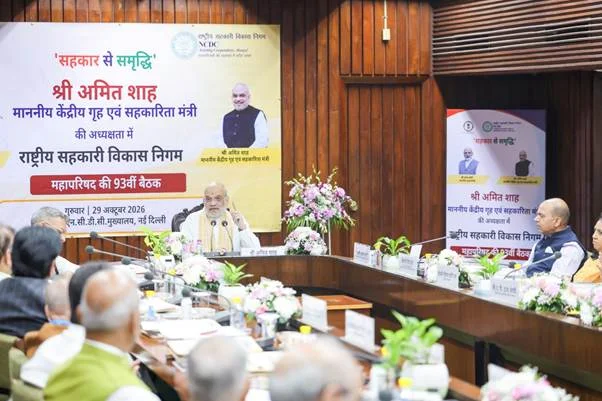
NEW DELHI: In a significant step towards realising Prime Minister Shri Narendra Modi’s vision of “Sahkar se Samriddhi” and accelerating cooperative-led development that reaches and includes every section of society, the 93rd meeting of the General Council of the National Cooperative Development Corporation (NCDC) was held today at the Corporation’s headquarters in New Delhi under the chairmanship of Union Home Minister and Minister of Cooperation Shri Amit Shah. The meeting deliberated on NCDC’s financial and institutional achievements, expansion of financing in the cooperative sector, development of new multi-state cooperative societies, strengthening rural livelihoods and various aspects of the Corporation’s future action plan.
Addressing the General Council meeting, Union Home Minister and Minister of Cooperation Shri Amit Shah said that NCDC had performed exceptionally well over the past nearly five years. The Corporation had not only made remarkable progress in financial performance and achievement of prescribed targets, but had also recorded important accomplishments such as higher profit per employee, expansion of loan sanctions and disbursements, and maintenance of zero net NPA. He expressed particular satisfaction that NCDC had now established its presence in all States and Union Territories of the country. The expansion of offices in remote areas such as Ladakh and smaller northeastern States was an important step towards taking the cooperative movement to the farthest corners of the country. Shri Amit Shah congratulated the Corporation’s officers and employees on these achievements.
Shri Amit Shah said that Prime Minister Shri Narendra Modi had fulfilled a decades-old demand of the cooperative sector by establishing a separate Ministry of Cooperation. Its objective was not merely to increase the number of cooperative societies, but to connect every citizen of the country with the development process. He said that the development of a vast country like India could not be measured solely by gross domestic product, per capita income or industrial investment. True development also meant ensuring that every section of society received opportunities, every citizen could live with dignity and everyone could contribute to national development. He said that development reaching everyone meant that its benefits should extend to every citizen, while inclusive development meant ensuring equal participation of all regions, from Ladakh to Lakshadweep, in the journey of progress.
The Union Home Minister and Minister of Cooperation said that cooperation was the most effective means of linking the collective strength of small farmers, livestock rearers, rural women, fishers and economically weaker sections, who have limited capital, with national development. Cooperative societies could bring large numbers of people together with modest capital and create new opportunities for production, processing, marketing and income enhancement. He said that Amul, IFFCO, Lijjat Papad and numerous other successful cooperatives across the country demonstrated that globally competitive institutions could be built by combining cooperative values with professional management. Referring to the outstanding performance of Indian cooperatives in international cooperative rankings, he said this was a matter of pride for the entire cooperative sector of the country.
Shri Amit Shah said that NCDC had expanded its activities into production, processing, marketing, rural industrial activities, water conservation, agricultural insurance, cooperative banking and the circular economy. The Corporation had also played an important role in the formation, capital investment and operations of national-level multi-state cooperative societies. He said that, considering NCDC’s achievements over the past five years, the period could be described as a golden era of sorts for the Corporation. However, it must not rest on these achievements. Wide-ranging reforms would be required in its institutional structure, ability to mobilise financial resources, professional functioning and models of partnership with cooperative societies to meet changing needs.
The Union Home Minister and Minister of Cooperation directed that a comprehensive roadmap be prepared for NCDC for the next 25 years. He said that a group of experienced representatives of the cooperative sector and professional experts should be constituted to examine the Corporation’s existing structure, alternative avenues of raising capital, participation of cooperative societies, financial autonomy, organisational reforms and future business opportunities. He suggested holding a workshop on these issues. Shri Amit Shah said that a special meeting should be convened after 31 March 2027 for a detailed presentation and discussion, so that progress towards the necessary decisions could be made by December 2027.
Shri Amit Shah said that the administration of cooperative institutions should be professional, while their fundamental outlook should be based on cooperative principles. Excessive dependence on government assistance and government banks imposed certain limitations on institutional development. NCDC should therefore develop financial and organisational models that would enable it to mobilise resources in line with its growing requirements and fully harness the potential of the cooperative sector. He said that development of the cooperative sector was NCDC’s responsibility, while ensuring NCDC’s own development should be the collective resolve of all members of the General Council.
The Union Home Minister and Minister of Cooperation appreciated NCDC’s role in developing institutions such as National Cooperative Exports Limited (NCEL), Bharatiya Beej Sahakari Samiti Limited (BBSSL), National Cooperative Organics Limited (NCOL), Bharat Taxi, Sahakar Sarathi and the umbrella organisation for Urban Cooperative Banks, NUCFDC. He expressed confidence that these institutions could emerge as large and influential national-level multi-state cooperatives in the years ahead. He said that, alongside providing financial assistance to large cooperative enterprises, bringing direct improvements to the livelihoods of small farmers, livestock rearers and fishers was an equally important responsibility of NCDC.
Citing the fisheries sector, Shri Amit Shah said that financial assistance had been provided through NCDC for approximately 100 trawlers for deep-sea fishing. Highlighting the social and economic impact of this initiative, he said such financing had the potential to significantly increase the monthly incomes of a large number of fishing families. Although a project of this scale might appear modest to a large financial institution, the resulting transformation in the lives of these families, their children’s education and future opportunities was extremely significant. He encouraged the Corporation to expand such grassroots initiatives further.
Shri Amit Shah also emphasised developing new circular-economy-based business models for cooperative sugar mills. Referring to proposed new multi-state cooperative initiatives in Kolhapur and Pune in Maharashtra, he said shared processing and industrial facilities could be developed for value-added products associated with sugar mills. This would particularly benefit cooperative sugar mills that were not in a position to undertake major investments or establish modern processing plants independently. Emphasis was placed on ensuring that profits generated through this arrangement reached the cooperative sugar mills concerned.
Emphasising greater youth participation, the Union Home Minister and Minister of Cooperation said that eligible young people who had completed training and internships under the “Sahakar Mitra” programme should be associated with new multi-state cooperative societies. This would encourage modern management, business efficiency and professional leadership in cooperative institutions. Referring to the successful management model of Banas Dairy, he suggested studying and drawing upon its experience in NCDC’s future functioning and institutional development.
Shri Amit Shah stressed the need to rapidly increase NCDC’s financial disbursements in the coming years. Referring to targets of ₹1.70 lakh crore for FY 2026–27, ₹2.10 lakh crore for FY 2027–28 and ₹2.50 lakh crore for FY 2028–29, he called for still more ambitious targets for subsequent years. He emphasised working towards disbursements of approximately ₹3.50 lakh crore in FY 2029–30 and ₹3.5 lakh crore in FY 2030–31. Shri Amit Shah said that, in view of expanding opportunities in dairy, fisheries, cooperative banking and other sectors, NCDC would have to build its financial capacity proportionately so that the financing needs of the cooperative sector could be met through cooperative-based institutional arrangements.
The Union Home Minister and Minister of Cooperation appreciated the support extended by the Reserve Bank of India and the Ministry of Finance towards NCDC’s development. He said positive cooperation had been received at various levels to address the Corporation’s financial and regulatory challenges, and efforts would continue to remove the remaining obstacles. He suggested that NCDC explore developing consortium and co-financing models with NABARD, State Cooperative Banks and commercial banks. He also stressed developing new financing models to meet the entire financial requirements of the dairy cooperative sector.
Giving special priority to the development of the northeastern region, Shri Amit Shah said that a target had been set to make the Northeast self-reliant in animal husbandry, dairy and fisheries by 2030. At present, a large proportion of these requirements was met from outside the region, even though the Northeast possessed substantial potential in dairy, fisheries and animal husbandry. He estimated that achieving self-reliance in these sectors could increase the Northeast’s income by approximately ₹32,800 crore and generate nearly eight lakh employment opportunities. He directed NCDC’s offices in the Northeast to prepare practical projects focused on these sectors, arrange the necessary financing and implement them in collaboration with State Governments.
According to financial details presented at the meeting, NCDC had cumulatively disbursed financial assistance of ₹4,14,586 crore to cooperative institutions across the country from the establishment of the Ministry of Cooperation up to 25 October 2026. During FY 2025–26, the Corporation sanctioned projects worth ₹1,55,408 crore and disbursed financial assistance of ₹1,27,596 crore. In the same period, it earned a net profit of ₹1,475 crore, while its loan recovery rate stood at 99.84% and net NPA remained zero. The Corporation’s annual disbursement increased from ₹24,733 crore in FY 2020–21 to ₹1,27,596 crore in FY 2025–26, representing an approximately fivefold increase over five years. The 3,339 units and projects sanctioned by NCDC during FY 2025–26 provided for benefits to 14,881 cooperative societies.
The meeting also discussed the significance of the National Cooperative Development Corporation (Amendment) Act, 2026. Passed by both Houses of Parliament and having received the President’s assent, the Act was published in the Gazette of India on 14 August 2026. The amendment expanded avenues for providing financial assistance for cooperative development, institutional participation and new opportunities for investment through equity and share capital. With the objective of making financial assistance more accessible and competitive for cooperative societies, the Central Government approved grant assistance of ₹2,000 crore for NCDC, enabling the Corporation to mobilise ₹20,000 crore from the market over four years. Under this initiative, loans amounting to ₹9,380 crore were disbursed in FY 2025–26 and ₹6,172 crore in FY 2026–27 up to 25 October.
To encourage innovation and entrepreneurship in the cooperative sector, NCDC has launched the “Sahakar Navachar Yojana”. Under the scheme, provision has been made for 100% grant assistance of up to ₹25 lakh to eligible cooperative societies. An initial fund of ₹10 crore has been established for the scheme, with 20% of the amount earmarked for cooperative societies in the northeastern region, hilly areas and disadvantaged sections. So far, grant assistance totalling ₹85 lakh has been sanctioned to five cooperative societies. In addition, guidance and support are being provided to cooperative societies in business development, digital accounting, financial management, branding and market linkages.
NCDC is also playing an important role in the formation and promotion of Farmer Producer Organisations (FPOs) to strengthen agriculture and the rural economy. The Corporation has registered 1,863 FPOs in the cooperative sector, including 1,117 FPOs formed through Primary Agricultural Credit Societies (PACS). Under the scheme, ₹356.90 crore had been disbursed to FPOs and related institutions up to October 2026. Various initiatives are also being undertaken to provide financial and institutional assistance to fisheries cooperatives, women’s cooperatives, dairy, animal husbandry, food processing and other rural livelihood activities.
To promote human-resource development and capacity building in cooperative institutions, extensive training programmes are being conducted by NCDC’s Laxmanrao Inamdar National Academy for Cooperative Research and Development (LINAC) and its regional training centres. During FY 2025–26, 21,688 participants attended 227 training programmes. The agreement between NCDC and IRMA (TSU) to strengthen modern management, digital technology, financial discipline, branding and professional efficiency in cooperative institutions is a commendable step.
The General Council meeting reviewed the audited annual accounts, annual report and financial performance for FY 2025–26, and deliberated on financial programmes for the coming years, resource mobilisation opportunities and the growing financing needs of the cooperative sector. Particular emphasis was placed on the Corporation’s long-term strategy in the context of the financial proposals on the meeting’s agenda and the ambitious future disbursement targets suggested by the Union Home Minister and Minister of Cooperation in his address.
Concluding his address, Union Home Minister and Minister of Cooperation Shri Amit Shah congratulated NCDC’s officers, General Council members and employees on the Corporation’s financial performance, zero net NPA and institutional expansion. He expressed confidence that, by continuously expanding its scope of work, financial capacity and professional functioning, NCDC would play an important role in realising Prime Minister Shri Narendra Modi’s vision of “Sahkar se Samriddhi” and making cooperation a powerful instrument of rural prosperity, employment generation, economic self-reliance and inclusive national development.