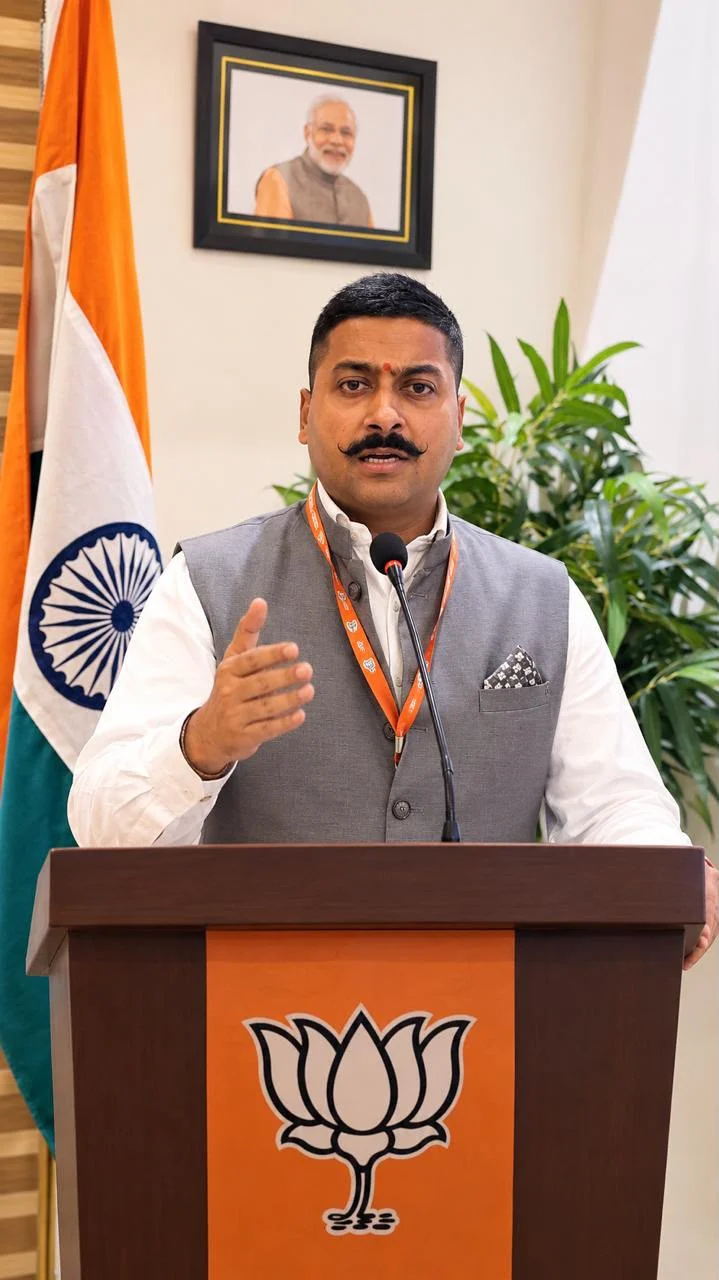
Jammu: Bharatiya Janata Party spokesperson and Convenor, International Affairs, Gaurav Gupta launched a sharp attack on Congress president Mallikarjun Kharge over his reported remark against Prime Minister Narendra Modi in Patna, accusing the Congress leadership of crossing the boundaries of political decency and turning democratic opposition into a campaign of personal attacks.
Reacting to the reported statement, “Modi ka baap bhi jayega,” Gupta questioned whether the Congress had run out of substantive political arguments and was increasingly resorting to provocative language to target the Prime Minister.
“First, the controversy surrounding remarks about the Prime Minister’s mother, and now a reference to his father. What message is the Congress trying to send to the country? Has the party run out of political issues to such an extent that it must drag family relationships into political battles? India expects a debate on governance, development, employment and national security—not personal insults from senior opposition leaders,” Gupta said.
Gupta emphasised that the office of the Prime Minister is a constitutional institution and that personal attacks directed at the country's elected head of government go beyond an ordinary political disagreement.
He said that Narendra Modi occupies the office through the democratic process and the support of elected representatives, reflecting the electoral mandate given by the people of India.
“The Prime Minister’s chair is a constitutional office, not a political punching bag. You may disagree with Narendra Modi, criticise his policies and challenge his government, but abusing the chair and reducing political debate to personal insults is an affront to the dignity of democratic institutions. It also shows disregard for the mandate expressed by millions of voters across the country.”
Gupta added that the Congress must understand that an electoral mandate cannot be undermined through rhetoric or personal attacks.
“An opposition party has every right to question the government, but it must do so with facts, arguments and alternative policies. The mandate of the people deserves respect, even when the opposition disagrees with the outcome. Democracy is not merely about the right to criticise; it is also about accepting the people's verdict with responsibility,” he said.
Gupta referred to several controversial statements attributed to Kharge over the years, arguing that the recurring disputes over political language warranted introspection within the Congress.
He cited Kharge’s 2019 election-related remark involving the possibility of Modi being hanged at Vijay Chowk; his November 2022 descriptions of Modi as “sardar of liars” and his reference to Ravana’s hundred heads; and his April 2023 comparison of Modi to a poisonous snake. Kharge subsequently clarified that the latter remark was directed at the BJP rather than Modi personally.
Gupta also referred to controversies surrounding remarks attributed to Kharge during 2024 and April 2026, including statements in Kerala and Chennai that generated political criticism and subsequent clarification.
“Repeated controversies over language directed at the Prime Minister should compel the Congress leadership to reflect. When senior leaders repeatedly find themselves at the centre of disputes over their words, the party must ask whether its political messaging is serving the country or merely fuelling confrontation,” Gupta said.
He maintained that the latest reported remark from Patna had once again raised questions about the standards expected of senior political figures.
“When arguments run dry, abuses fly. Personal attacks may generate headlines, but they cannot replace a credible political vision. The Congress must explain what it offers the country beyond rhetoric and controversy.”
Turning his attention to Rahul Gandhi, Gupta questioned the Congress leadership’s priorities and said the party must demonstrate sustained engagement with the country's pressing challenges.
He argued that the Congress should focus on economic growth, youth employment, national security, infrastructure, farmers’ welfare and India's international standing instead of allowing controversies surrounding its senior leaders to dominate the political narrative.
On Rahul Gandhi’s foreign travel, Gupta said public figures were entitled to travel, but political leaders must remain accountable for their public commitments, availability and engagement with national concerns.
“The Congress itself is inviting questions about Rahul Gandhi’s priorities. If the party wants to project him as its principal national leader, it must explain how his political commitments, public engagement and response to pressing national issues reflect that responsibility. The BJP does not need to manufacture a narrative about Rahul Gandhi’s priorities; Congress leaders must answer questions arising from their own political conduct and public statements.”
Gupta added that the country needs an opposition that presents credible alternatives and holds the government accountable through meaningful debate rather than personal attacks.
Gupta called upon the Congress leadership to clarify its position on the latest controversy and demonstrate that political disagreement can remain forceful without becoming personally abusive.
“An opposition party is essential to democracy, but an effective opposition must challenge the government with facts, arguments and alternatives. Merely attacking the Prime Minister personally does not constitute a national policy. Nor does a provocative statement become an achievement simply because it attracts headlines,” he said.
Concluding his remarks, Gupta urged the Congress to move beyond personal attacks and focus on constructive opposition, policy accountability and public concerns.
“Political power is temporary, but the standards leaders establish in public life leave a lasting impression. The Congress must decide whether it wants to contribute to meaningful democratic debate or continue to be embroiled in controversies generated by the language of its own leadership. India deserves an opposition that respects democratic institutions, honours the people's mandate and puts national interest above political provocation,” Gupta said.